Those of us who are in our first year of simple vows here at the Dominican House of Studies have just been assigned to new ministries in the Washington, D.C. area. These ministries vary widely. Some brothers run a parish youth group; others work with the Missionaries of Charity; still others visit the elderly at nursing and assisted care facilities. Most of our assignments require a certain amount of travel, but one of them—that of tour guide at the Basilica of the National Shrine of the Immaculate Conception—is just across the street.
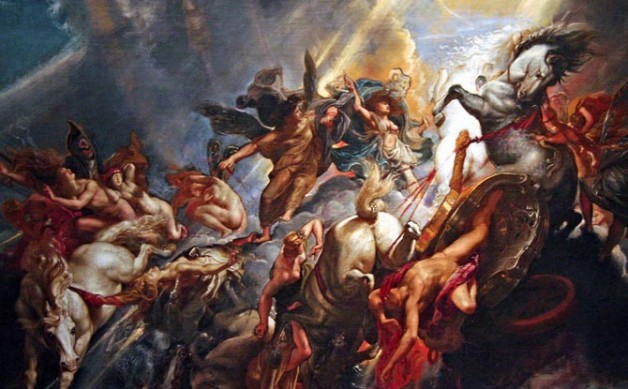
The myths of the Ancient Greek and Latin poets tell us the tragic tale of Phaeton, the son of Apollo. Apollo, the god of light, carried out the enormously important task of driving the flaming chariot of the sun across the sky each day. Now, Phaeton was raised without knowledge of his father’s identity, and when he discovered, as he eventually did, who his father was, he approached him in the temple of light and asked to drive “the car of day.” Apollo, full of love and concern for his son, denied him his request. Again and again, Phaeton begged to drive the chariot, but each time Apollo refused. Finally, coming to his father another day, Phaeton besought him for proof of his sonship. Not wishing his son to be denied, and in order to verify his hereditary claim, Apollo consented to whatever Phaeton should ask.
As the legend goes, Phaeton then told his father, for the last time, that he wished to drive the chariot of the sun. Apollo begrudgingly granted his request, but begged him to withdraw it. The next morning, as night passed through the world’s western gates, Phaeton seized the reins of his father’s chariot. He was a strong youth, but as he mounted up the sky, the chariot’s horses proved too wild and violent for him to control. He careened toward the earth, and, as the chariot crashed into the ground, the world was set ablaze.
This myth contains certain deep, perennial truths about the human condition that continue to resonate with us today. The first bears upon a son’s desire for acknowledgement, for it seems at times we Christians are tempted to believe we must prove ourselves worthy before our Heavenly Father. In reality, however, we cannot do anything to prove our filial relationship with God, for He has claimed us as His own. As Saint Paul says, “We were buried with him by Baptism into death, so that as Christ was raised from the dead by the glory of the Father, we too might walk in newness of life” (Romans 6:4). In Baptism, God bestows on us a character by which we remain forever marked as his. Furthermore, he grants us a share in his own Holy Spirit through the Gifts of the Holy Spirit. We are made his sons and daughters in the free gift of the sacrament of Baptism.
Another profound truth this myth conveys is the need for humility. True humility, that is, knowing oneself as one is, proved to be beyond Phaeton. Had Phaeton known his limits and his place in the order of the world, he would not have tried to undertake a task that lay forever beyond his reach. Similarly, the Christian ought to have an appropriate self-knowledge. In his letter to the Ephesians, Saint Paul tells us that “grace was given to each according to Christ’s measure” (4:7); and, further on, he says, “He gave some as apostles, others as prophets, others as evangelists, others as pastors and teachers” (4:11). In other words, there is a wide variety of interests, personalities, and accomplishments among the saints; we do not have to fit a stock mold. So, rather than building up visions of achievement for ourselves, as Phaeton did, we must be open to God’s plan.
Finally, we need not fear the abandonment Phaeton suffered. God will not forsake his children; this he has promised us: “Can a mother forget her infant, be without tenderness for the child of her womb? Even should she forget, I will never forget you” (Isaiah 49:15). The love our Almighty Father has for us is so great that, even if we insist on “driving the chariot” and thereby find ourselves in the midst of a truly dire situation, we have but to call on his Holy Name, and we will find our Father running to our side.
✠
Image: Sir Peter Paul Rubens, The Fall of Phaeton
I’d like to say that I knew what I was doing when I asked to take the religious name “Thomas” (after St. Thomas Aquinas), but that just wouldn’t be true. While it wasn’t exactly a spur-of-the-moment decision, it was certainly based more on inclination than any well thought-out reasons. Of course, I had some inkling of who my patron was: a great genius who wielded his intellect in the service of the Truth; a profoundly prayerful man whose greatest recorded words of devotion were reserved for the Eucharist. This basic portrait was enough for me at the time, but I knew I had so much more to learn.
Nearly two years have passed since the Patient Protection and Affordable Care Act—the centerpiece of what is sometimes referred to as “Obamacare”—ushered in the promise of universal healthcare coverage. While legislators, regulators, and the President himself have acknowledged that the legislation is less than perfect, the law’s proponents continue to argue that, by ensuring the sort of basic care necessary for sustaining general health, the bill represents a step in the right direction.
Under the provisions of the Act, much of the task of defining what constitutes “health care” was left to governmental regulators. For example, the law looks to the U.S. Department of Health and Human Services (HHS) to determine which drugs and services will qualify as “preventive” care.
Last Friday, HHS took a significant, if unfortunate, step in this process when it announced that, in its final set of rules, “preventive services for women” will include contraceptives, female sterilization procedures, and related “patient education and counseling for all women with reproductive capacity.” When this provision takes effect next year, all but a very narrow class of organizations and individuals will be compelled to purchase prescription coverage for contraception and female sterilization.
Every athlete exercises discipline in every way. They do it to win a perishable crown, but we an imperishable one. Thus I do not run aimlessly; I do not fight as if I were shadowboxing.
—1 Corinthians 9:25-26
The 2005 film, Cinderella Man, tells the remarkable story of Irish-American boxer James J. Braddock (1905-1974). Braddock, played by actor Russell Crowe, enjoys a successful career as an amateur boxer until life takes a turn for the worse at the threshold of the Great Depression. Like so many other Americans during that tumultuous time, Braddock struggles to make ends meet, barely managing to support his wife and three young children. In the end, however—as the title of the movie suggests—his life plays out like a modern-day fairy tale. His boxing career gradually picks back up, and the film ends triumphantly when he becomes the heavyweight champion of the world. He and his family, as the saying goes, live happily ever after.
Braddock is portrayed as the kind of person we all want to rally behind. Yet our sympathy for him goes beyond mere support for the underdog, mere pity for his life of hardship. There is actually something we come to love in James Braddock: he is a good man.
The felicity of this life consisteth not in the repose of a mind satisfied. For there is no such finis ultimus (utmost aim) nor summum bonum (highest good) as is spoken of in the books of the old moral philosophers. Nor can a man any more live, whose desires are at an end, than he whose senses and imaginations are at a stand. Felicity is a continual progress of desire, from one object to another, the attaining of the former being still but the way to the latter.
—Thomas Hobbes, Leviathan, 1668
The conception of felicity proposed above, while opposed to the inherited wisdom of two millennia of moral philosophy, says something significant about the way in which man experiences the animating effect of desire and the inevitability of its frustration. Hobbes argues that since the summum bonum cannot be grasped in this life, it cannot provide a guide to man’s action. If God cannot be grasped here and now, we should not pretend that He is relevant to man’s desires, or that He could provide a solid foundation for a moral theory based on man’s pursuit of happiness.
Notice what happens, however, once man’s final end is removed from moral consideration.
At the National Basilica of the Immaculate Conception—above your head as you walk in—there is a bas-relief. At its top a dove hovers aloft, and rays emanate from its wings in all directions, drawing men and women heavenward. The dove, of course, represents the Holy Spirit, and the sculpture as a whole portrays the “universal call to holiness.”
The “universal” aspect of the call to holiness might surprise us.
Certainly sons are a gift from the LORD,
the fruit of the womb, a reward.
Like arrows in the hand of a warrior
are the sons born in one’s youth.
Blessed is the man who has filled his quiver with them.
He will never be shamed
for he will destroy his foes at the gate.
—Psalm 127:3-5
We all know that the Ten Commandments require us to “honor thy father and thy mother,” and elsewhere in Exodus the Lord declares, “Whoever curses father or mother shall be put to death” (21:17). But have we considered the full meaning of these commands?
Last week veteran NFL quarterback Fran Tarkenton wrote an article in the Wall Street Journal in which he mused on the intersection of faith and football. A religious man himself (“charismatic before charismatic was cool,” he says), Mr. Tarkenton raises some questions that not only have serious weight for football fans, but also provide an occasion for genuine theological reflection. “Does God care who wins football games?” he asks. Is which team wins important enough for God to care about? Should we look for divine causality in amazing plays like Roger Staubach’s 1975 “Hail Mary” pass and Franco Harris’s “Immaculate Reception” in 1972? Does having religious men on one team or the other increase the likelihood of winning? And finally, “If God gets credit for the win, does he also take blame for defeat?”
Since theology treats not only of God but of all things as related to God, let us see if the riches of the Catholic theological tradition can provide some satisfying answers to these questions, or, at least, help to advance the conversation.
One does not usually find oneself giving voice to a deep yearning for Bertrand Russell’s atheism. And yet, stuck in traffic and riding shotgun, I recently found myself doing just that. It’s not that I wished I were an atheist like Bertrand Russell. Rather, I wished atheists were atheists like Bertrand Russell. The context was a conversation about the famous BBC debate on the existence of God between the brilliant Oxford Jesuit, Fr. Frederick Copleston, and the infamous analytic philosopher, Bertrand Russell. The point was that many of today’s atheists don’t hold a candle to Russell in terms of logical consistency and rigor of argumentation. With Russell, you got a debate. With most of our guys, you get a merry-go-round.
But isn’t that somewhat unfair? It is, but only because it doesn’t go far enough.