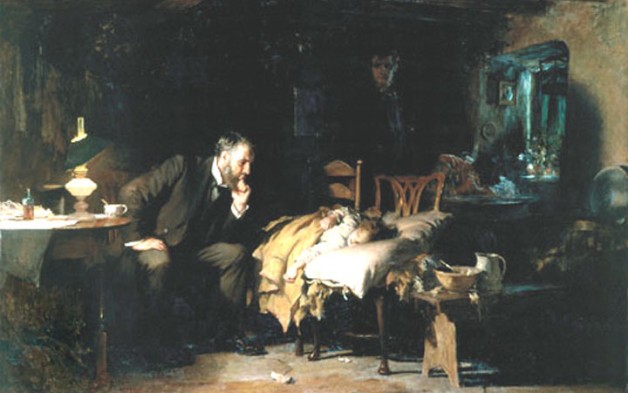
If you are like me and grew up attending religious education classes of some sort, you may have come across the line, “If God stopped thinking about you at any instant, you would immediately disappear; you would cease to exist.” What a terrifying thought to offer the inquisitive mind of a child! The suggestion seems to be that, on occasion, either through forgetfulness or malice, God annihilates some unfortunate person or persons. But this is not true; God doesn’t even annihilate demons or the damned, much less unsuspecting third graders.
As religious liberty and conscience protection are threatened in our country, it seems opportune to reflect upon our relationship to the state as Catholic Christians. In doing so, it can be helpful to look to the book of history, for this is not the first time the Church has found herself caught “between a rock and a hard place.” Republican presidential candidate Rick Santorum, for one, has attempted his own historical analysis, comparing the philosophical underpinnings of the Health and Human Services contraception mandate to the ideology that fueled the atrocities of the French Revolution. While it is certainly surprising to hear an American presidential candidate warning about the philosophical dangers of the ideals of the French Revolution, there are nonetheless apt parallels.
Under the provisions of the healthcare bill that became law last year, individuals and groups are forced to purchase health insurance plans that cover a broad range of medical services, including preventive health care for women. As is well known, the Department of Health and Human Services, under the Obama administration, has recently declared that the category of “preventive health services for women” will include not only such uncontroversial procedures as mammograms and screenings for cervical cancer, but also contraception, abortion-inducing drugs, and sterilization. While there has been much uproar over the inadequate conscience clauses built into the regulation, less attention has been paid to an equally important matter: what constitutes “health care” or “medicine?” Is contraception really health care?
In Lent 2011, the Dominican student brothers gave a series of conferences, viewing the Cross from a number of different angles.
In the video below, Br. Cajetan Cuddy, O.P., presents a talk entitled “The (Other) Good Thief,” in which he explores the twisting path carved by the grace of Christ’s cross in the life of Jacques Fesch, a 20th-century murderer whose life was radically changed by the encounter with Christ.
Find the schedule and locations of student-brother conferences for Lent 2012 here.
Today is the first Friday in Lent, the day when Americans dust off their recipes for fish casserole and settle in for the season of penance. “Prayer, fasting, and almsgiving” is the traditional way of expressing the Catholic Lenten regime. Specifically, the Church assigns meat as something Catholics must give up on Fridays. Additionally, each Catholic usually sacrifices something that is important to himself, such as sweets, coffee, TV, or the Internet (but not of course the Dominicana Blog). These little acts of self-denial are a unifying force. Like ashes on Ash Wednesday and palms on Palm Sunday, giving up something for Lent and abstaining from meat on Fridays have deep cultural roots. But what is the purpose of our penance?
“The good man is the measure of things to be done.” This principle—that the life and character of a truly virtuous man provide us with the best standard for deciding how to act—is at the heart of Aristotle’s approach to the moral life. It’s also at the heart of common sense, because we all know that morals isn’t math. We all know that ethics concerns what is irreducibly human and, therefore, inherently unquantifiable. Or most of us do.
Today is Ash Wednesday. Lent is upon us once more, and over the next few days we will all be taking up spiritual disciplines of one kind or another, each according to his or her circumstances and state in life. During this season in particular, we are invited to adopt practices from all three of the traditional categories of Christian observance—prayer, fasting, and works of mercy—and so to open ourselves up to God’s grace in an authentic and integral way. While all three are very important, prayer might be said to have a certain priority. Prayer is, after all, the only thing Scripture tells us to do “always” or “continually.”
This Lent, I would like to propose for our consideration one of the most popular and venerable forms of Lenten prayer, the Stations of the Cross. Specifically, I would like to recommend the Stations in their traditional, fourteen-part form, ending with the Burial of Jesus and stopping short of the Resurrection, which many people add to the Way of the Cross, calling it the “Fifteenth Station.” Far be it from me, of course, to presume to forbid anyone from concluding the Stations with a meditation on the Resurrection. I simply notice that in some circles the deep meaning and significance of the Via Dolorosa, the “Dolorous Way,” seems to be in danger of being forgotten. The traditional form of the Stations, celebrated on Friday and concluding with the Burial, is in fact eminently fitting in at least four different ways: liturgical, historical, mystical, and practical. Let us take a brief look at each of these.
Today, many Catholic countries, and some not-so-Catholic countries, are celebrating the last day before the beginning of Lent. Whether it is called Carnivale or Mardi Gras, some features are universal: lots of food and drink, lavish parties in the streets, and, interestingly, masks.
Choosing a name is a difficult task, whether it is undertaken by parents naming their child, postulants proposing a religious name, or pontiffs choosing their papal patron. Is it better to choose a name that is common, or unique? Will my child be better off as one of the 17,030 Jaydens born in 2010, or would he be better of as one of the 196 Sheldons? Should I ask the Novice Mistress for “Sister Pat,” or show my admiration for Holy Father Dominic by going for “Sister Ebur Castitatis?” I know I’m not supposed to be “Peter II,” but should I stick with “Benedict XVII” or go for “Pius XIII?”
It is a fact widely acknowledged that man’s common intellectual heritage suffers from a dearth of theological analyses of Sherlock Holmes. Emboldened by the direness of the need, I will overlook the inadequacies of my own pen and turn now to make some small redress of this lamentable paucity.