Under the provisions of the healthcare bill that became law last year, individuals and groups are forced to purchase health insurance plans that cover a broad range of medical services, including preventive health care for women. As is well known, the Department of Health and Human Services, under the Obama administration, has recently declared that the category of “preventive health services for women” will include not only such uncontroversial procedures as mammograms and screenings for cervical cancer, but also contraception, abortion-inducing drugs, and sterilization. While there has been much uproar over the inadequate conscience clauses built into the regulation, less attention has been paid to an equally important matter: what constitutes “health care” or “medicine?” Is contraception really health care?
Some say that contraception or, more specifically, the birth control pill, does not qualify as “medicine” because it has adverse effects on a woman’s health. They point out, for example, that the birth control pill is carcinogenic. While this is true, it misses the mark. The harmful side effects of the birth control pill are indeed an excellent reason to avoid using it, but we should recall that such effects are inherent to and, to some degree, acceptable in, any medicinal drug.
All the same, the basic intuition here—the connection between medicine and health—is sound. We are correct to suppose that medicine must be ordered to health in some way, and in this we have the beginning of an answer to our question.
Perhaps a distinction from Aristotle can help us to go a little further. Aristotle tells us that any art or practical science, such as medicine, involves working on some object for the purpose of producing some result or outcome. The sculptor, for instance, plies his art on a piece of marble. The teacher teaches a student. And the object of the art, be it a stone or a person, always bears what Aristotle calls a “passive potency” or an “active potency.”
The sculptor’s marble is an excellent example of an object that has passive potency. It is capable of being sculpted; it can be shaped according to any form that the sculptor imparts. The cause of the sculpture is most properly an exterior cause: the sculptor. He is the principal agent who shapes the marble, while the marble itself is only a “cause” insofar as it is receptive to the form imparted. Thus, the superior or inferior quality or the sculpture is primarily attributable to the sculptor, not the marble.
The student, on the other hand, has an active potency. He is capable of learning either through a process of discovery, or through being aided by an instructor. This is because the power to learn resides in the student’s intellect, not in the teacher. A teacher, strictly speaking, cannot “teach” the student; he can only help the student teach himself. The principal agent in learning is the student. Thus, a failure in learning is primarily attributable to the student, not the teacher—even though the teacher can certainly help or hinder the process.
Turning to medicine, we can see that the relationship between a doctor and patient is like the relationship between a teacher and student. Like the student (and unlike marble), the body has an active rather than a passive potency. As St. Thomas says, “In healing the doctor assists nature, which is the principal agent, by strengthening nature and prescribing medicines, which nature uses as instruments for healing.” Thus, we can either become healthy on our own, or with the aid of a doctor, but in either case it is our body that principally does the healing, not the doctor. Accordingly, the doctor is held accountable for the body’s failure to heal only to the extent that he is negligent or practices his art poorly.
So, in light of these distinctions, why can’t contraception be described as medicine? Fundamentally, because the art of medicine aims at the health of the body, and the principal agent in healing is not medicine, which is only an instrumental and secondary cause of health, but the nature of the body itself. To put it somewhat crudely, it is the job of medicine to help nature “achieve” its end—its active potency for health. Now, reproduction is one of the characteristic signs of life, and a functioning reproductive system is clearly a sign of health and vitality. But contraception does not aid the functioning of the reproductive system; it does not help nature to achieve its end. Rather, it does the opposite; it thwarts and reverses nature’s bent. Thus, the birth control pill, precisely as an instrument of contraception, cannot adequately be described as “medicine.” We might add that, if contraception were medicine, then pregnancy would be a disease, which is absurd.
St. Thomas says that an unjust law is not really a law at all, but is more appropriately described as an act of violence. And, while it is true that violence can compel many things, it cannot compel pregnancy to be a disease or contraception to be medicine. Truths such as these are founded, not upon the will of men, but upon the nature of things.
✠
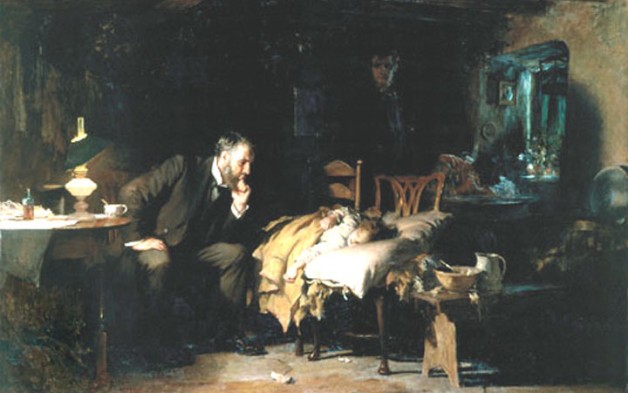
Image: Sir Luke Fildes, The Doctor