On the evening of Thursday, April 22, 2010, I was standing with my novice brothers outside St. Gertrude Priory in Cincinnati, Ohio, waiting to leave for a pro-life dinner downtown. I happened to be holding one of our cell phones, and, shortly before we got into the vans, I received a call I will never forget.
On hearing the word “asceticism,” a number of associations rush to mind. Most typically, we recall the standard fare of Lenten practices—fasting, abstinence, perhaps the sacrifice of some beloved comfort. For the most part, we tend to associate asceticism with foregoing some secondary good, be it satiety at the end of a meal, red meat, or warm showers. While this is the beginning of a healthy understanding of penance, it does not entirely capture its spirit. It is not too difficult to see how the disposition in which these practices are conducted could be self-centered: Lent approaches. I brainstorm things to do that are difficult. I do them for Jesus. Easter rolls around, and I revert to past practices. While perhaps it is implicit, the central reality of conversion falls to the periphery in this approach to asceticism. Rather, what assumes an exalted status is the disciplined flexing of one’s penitential muscles.
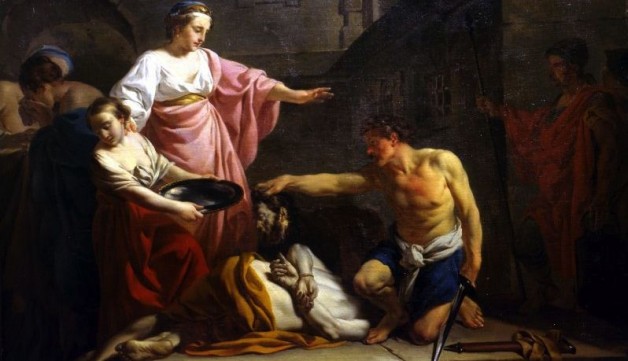
Today’s feast, alternately called “The Passion of Saint John the Baptist,” “The Martyrdom of Saint John the Baptist,” and “The Beheading of Saint John the Baptist,” is not only a reminder to “keep one’s head” and not overindulge in food and drink when entertaining and making merry—it also reminds us that it is neither losing our good reputation nor the threat of man that we should fear, but God alone.
I still remember the first time I encountered the writings of St. Augustine. I was taking a class called “Augustine and Aquinas” in college and had to read Augustine’s Confessions alongside Aquinas’s Compendium of Theology. The difference between the two was striking. Compare Aquinas and Augustine on man’s last end:
Our natural desire for knowledge cannot come to rest within us until we know the first cause, and that not in any way, but in its very essence. This first cause is God. Consequently, the ultimate end of an intellectual creature is the vision of God in His Essence. (Compendium, 104)
And now Augustine:
You stir man to take pleasure in praising you, because you have made us for yourself, and our heart is restless until it rests in you. (Confessions, I.1)
Which one do you think captivated a college student in search of God?
I’m going to show the people that this city doesn’t belong to the criminals and the corrupt . . . People need dramatic examples to shake them out of apathy . . . A man is just flesh and blood, and can be ignored or destroyed. But . . . as a symbol I can be incorruptible, everlasting.
“What symbol?”
I’m not sure yet. Something elemental. Something terrifying.
There are many heroes on whose lips these words would not be out of place. This particular quote, however, belongs to Bruce Wayne at the beginning of Batman Begins, the first of Christopher Nolan’s Batman trilogy. Anyone who has seen these movies recognizes that the Batman is an awesome and terrifying figure. An expert in dozens of martial arts and just generally intimidating in his armor and bat-gear, he is the one man that Gotham’s criminals fear. But there is more to this fighter than his skill and equipment. These are only the surface of what it means to be “the Batman.”
And Philip found Nathaniel, and told him, “We have discovered who it was Moses wrote of in his law, and the prophets too; it is Jesus the son of Joseph, from Nazareth.” When Nathaniel asked him, “Can anything that is good come from Nazareth?” Philip said, “Come and see.” Jesus saw Nathaniel coming towards him, and said of him, “Here comes one who belongs to the true Israel; there is no falsehood in him.” Nathaniel said to him, “How do you know me?” Jesus answered him, “Before Philip called you, when you were under the fig tree, I saw you.” Nathaniel answered him, “Rabbi, you are the Son of God! You are the King of Israel!” Jesus answered him, “Because I said to you, I saw you under the fig tree, do you believe? You shall see greater things than these.”
—John 1:45–50
In proclaiming this Gospel passage today, on the feast of the Apostle Bartholomew, the Church follows and endorses a long tradition according to which Bartholomew and the disciple here referred to as Nathaniel are actually the same person. There are many reasons for supposing that this tradition is sound.
Today we are celebrating the sainthood of Rose of Lima. St. Rose is a fellow Dominican, who died at the age of 31 in the year 1617. She also has the mark of being the first saint canonized from the “New World” or the Americas. St. Rose is most well known for the penances she inflicted upon herself. These included not eating meat or fruit for most of her life, sleeping on a bed strewn with rocks and broken glass when she was not depriving herself of sleep altogether, wearing a crown of thorns concealed by roses or her habit veil, and living in a tiny hermitage in her parents’ backyard.
These are shocking to read about in a way. Why on earth would someone inflict such pain and torture on herself? Her penances might even lead someone to accuse her of abusing her body, her own temple of the Holy Spirit!
Today the Church celebrates the Queenship of the Blessed Virgin Mary. Since we Americans do not live under a monarchy, it might be tempting for us to think of a queen as a merely historical personage, as someone whose influence is frozen in the past. But this is not the case with the Blessed Virgin Mary. She was a real, historical person, who walked the earth about two thousand years ago, but she is not limited to history. She still lives, body and soul, in heaven, and even now her powerful intercession brings about real effects in our lives and in our world. By celebrating her Queenship, the Church draws our attention to this fact. Mary is a queen whose reign has not ceased and never will cease.
During college, I was in a small Catholic reading group, and in various books we kept coming across stories of conversions brought about by Our Lady’s intercession. Up to that point in my life, I thought that most conversions were brought about by intellectual means or, perhaps, through a serious illness. I figured that Our Lady’s role in conversion was almost always remote or imperceptible. Accordingly, I posed a question to the reading group: “Does anyone know someone who was converted to the Catholic faith due to Mary’s intercession?”
In commemoration of the opening of the new academic year at the Dominican House of Studies, we invite you to revisit an article published in the Winter 2011 issue of Dominicana: ✠ J. Augustine Di Noia, O.P., “Theological Method and the Magisterium of the Church,” Dominicana 54:2 (2011) 51-61.
In this article, Archbishop Di Noia shows that the Magisterium is not merely an intrusive, external authority, as it is often portrayed. By working and thinking within the framework established by the Magisterium, the intellectual integrity of Catholic theologians is safeguarded and fostered, not undermined. This article complements the Archbishop’s article “Discere et Docere: The Identity and Mission of the Dominican House of Studies in the Twenty-First Century,” which appeared in The Thomist 73:1 (2009) 111-127.
The students at the Dominican House of Studies ask our readers to keep us in your prayers as we continue our formation within the Dominican theological tradition this academic year.
✠
Image: Archbishop Di Noia preaching at 2012 Ordination Mass for the Province of St. Joseph at St. Dominic’s Church in Washington, DC.
We give thanks to God for the solemn profession made by four of our brothers on Saturday, August 11. From left to right, they are Br. Gabriel Joseph Torretta, O.P., Br. Sebastian White, O.P., Br. John Maria Devaney, O.P., and Br. Thomas More Garrett, O.P.
To all the members of the Province of St. Joseph, let me say this: be happy that Dominic has called you to share his spirit as a brother, in the community of brothers which is the Province of St. Joseph. Love Dominic, love your province, love your brothers. Dominic and his spirit is the reality which binds us together as brothers in the Lord. Dominic has to be very close to the heart of each of us.
—Fr. Vincent de Couesnongle, OP, from a letter written as Master of the Order to the Province of St. Joseph on the Feast of the Holy Innocents, December 28, 1982