Obedience: few words are more likely to make an American shudder. It’s practically a swear word, like “truth,” “humility,” or “hierarchy.” We are a nation that was built upon liberation from a monarchical government, which our forefathers resented for imposing taxes on their tea and playing cards. Yet, as tempting as it might be to focus on the problem of obedience as something peculiar to the United States or even to modernity, we know that it’s nothing new:
The disobedient walk proudly, carrying the head of self-will high. And if they are sometimes forced to obey they do not bow down in humility but pass through the door proudly.
So said Catherine of Siena, referring to religious brothers and sisters in the fourteenth century. The Book of Genesis declares that disobedience was the sin of Adam, the root of original sin, and even the ancient pagans recognized the deadly effects of hubris. It makes sense, then, that obedience is difficult for us, and will continue to be difficult. We might even be tempted to despair and ask, “Why bother trying?”
Obedience is difficult because of what it is: the giving over of our will to another or, put another way, choosing to do what another chooses. Parents expect their children to obey them. Employers expect their employees to follow their directions. Obedience is a fundamental part of human society because it is a necessary part of justice, or giving what is due to others. This does not mean we do absolutely anything our “superiors” ask us to do, but it does mean we obey them in matters over which they have authority, as long as what they ask does not contravene the moral law. We do the extra spreadsheets that seem entirely unnecessary, but which our boss wants done. We follow our teacher’s directions on how to write a paper, even if we prefer another style. We listen to our parents’ life lessons and try to put them into practice, even if we don’t fully understand them.
We can see how obedience is necessary even in a merely human way, for the purposes of a well-ordered society, but it also operates on a much deeper level. Through obedience we can show God that our love for Him is genuine. “I’m going to do what my conceited co-worker is asking me to do on this project, even if he is incredibly annoying, and I’m going to do it for the love of God, who has placed me here at this particular time.” By offering our will to God in situations such as this, we imitate Christ himself, who “learned obedience” (Heb 5:8) in his humanity:
Christ Jesus, though he was in the form of God, did not count equality with God a thing to be grasped, but emptied himself, taking the form of a servant, being born in the likeness of men. And being found in human form he humbled himself and became obedient unto death, even death on a cross. (Phil 2:5–8)
By obedience we become like Christ, who was obedient to His Father’s will, demonstrating in his own body that obedience is our means of sanctification. St. Catherine makes this point multiple times in her Dialogue: “Only the obedient can attain eternal life, for eternal life, which had been locked by Adam’s disobedience, was unlocked by the key of obedience.” The obedience of Christ frees us from sin and death and enables us to participate, by our own act of obedience, in the life of God.
Of course, obedience is not something limited to religious or to Christians, but it should be more evident and profound in those who have been conformed to Christ by Baptism or the profession of vows. Obedience is the path of the saints to perfect love. As St. Catherine writes, “Your entire faith is founded on obedience, for it is by obedience that you show your fidelity.” Obedience is the sign of fidelity, and fidelity is the sign of love. Our love and fidelity show themselves in repeated acts of obedience, over time and in difficult circumstances. This highlights the importance of patient humility: those who believe in, hope for, and love the Word they have heard will be obedient to that Word until the end.
In times of widespread dissent and individualism, we need to cultivate the virtue of obedience and affirm its value once again. Obedience is ultimately about giving what is due to Him who has given us all we have and are, including the power to know and will anything at all. Far from restricting our lives, obedience frees us to love God as He has loved us—unto death.
✠
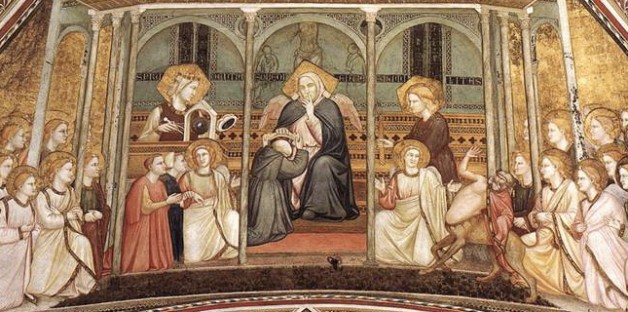
Image: Giotto, Allegory of Obedience (detail)