When Socrates had received his sentence, he stood up to address the assembly for the last time. He predicted that those who had convicted him would incur a bad reputation. To the Western mind, that’s putting it mildly: as an account of martyrdom for the sake of truth, the Apology of Socrates is second only to the Passion of the Christ. But Socrates hasn’t pleased everyone: Nietzsche had his doubts, and, what’s more, some museum-goers in Chicago are positively unimpressed.
On January 31, the National Hellenic Museum hosted a retrial of “the biggest freedom of speech case of all times.” Defending Socrates were eminent local lawyers Dan K. Webb and Robert A. Clifford. The prosecution was led by former U.S. Attorney Patrick Fitzgerald, who won convictions against the Gambino crime family, two Illinois governors, and Vice President Cheney’s chief of staff. A jury of a thousand ticket-holders spared Socrates the death penalty, accepting the alternative that Socrates himself finally proposed at his original trial, a fine of 3000 drachmas (i.e., as many days’ wages).
They convicted Socrates—again! After I recovered from the initial shock (“—and a museum of Greek culture, too!”), I began to wonder whether staging a retrial of Socrates was a common practice, a sort of classroom exercise such as trying Aeneas for his desertion of Dido or holding a debate on who’s more heroic, Hector or Achilles. I was looking for some precedent—how many times has he been reconvicted? In fact there were some fairly high profile reenactments recently, one in New York in 2011 and another in Athens the following year. In both the defendant was acquitted. But three recent trials hardly amount to a tradition, and, on second thought, it’s clear why we haven’t made a habit of this: between Socrates and Athens there really is no contest. Socrates is the hero. It’s really not very debatable.
I do admit that it is now somewhat fashionable to wax too shrewd for Socrates. One hears it said, even among persons of philosophical affiliation, that the man was intolerably self-absorbed, disingenuous, arrogant, obstinate, sophistical, possessed of an acute persecution complex, and so on. Not only is such characterization rather dubious; it’s beside the point. We don’t condemn people to death for being rude. And it is difficult to read very widely in Plato without being struck by Socrates’ peculiar combination of zeal for the truth and joie de vivre. There is a large tradition that he was exceptionally gracious, magnanimous, and funny. Thoroughly thrifty, he was remarkably hygienic. He liked to dance and drank heartily (though he was never drunk). His mind was penetrating and unaccountably lofty, yet even into his late forties he was a fierce infantryman. As Alcibiades described him in the thick of battle, “he was observing everything quite calmly, looking out for friendly troops and keeping an eye on the enemy. Even from a great distance it was obvious that this was a very brave man, who would put up a terrific fight if anyone approached him.” He was uncommonly pious and just, yet charmingly self-deprecating. He loved talking with people, and he loved his city. Euthyphro called him the heart of Athens.
More to the point was the main tack taken by the prosecution in Chicago: that the Athenian jury is shown to be justified in the light of the historical context of the trial. At the end of the fifth century, Athens had lost the Peloponnesian War, suffered a severe plague, and endured a reign of terror by an oligarchic cohort later known as the Thirty Tyrants. We might expect that the Athenians were feeling out of favor with the gods. Here’s where Socrates’ supposed impiety comes in. Prosecutor Fitzgerald connects the dots: “Messing with the gods brings real harm . . . The gods have a memory, and they carry a grudge.”
But Western polytheism is a mere cultural artifact. Surely Socrates’ critique of Homeric theology was a step in the right direction. Again, not that he was irreligious. For him, piety was a kind of justice. Indeed, he understood his whole philosophical life as a kind of defense of divinity. And isn’t it odd that an age obsessed with the separation of church and state should judge that Socrates indeed deserved death simply because the theocracy in which he lived condemned him?
Funny enough, Socrates’ contemporary detractors bear some resemblance to those who now exalt him as a mere champion of free speech—as if that he stood out were more important than what he stood for. A certain relativism forbids the former group from passing judgment on the Athenians, while a certain egalitarianism prevents the latter from fully recognizing Socrates as exceptionally wise and good—for that would mean that others aren’t. According to a more traditional egalitarianism, everyone can benefit from Socrates’ example and teaching, even if the virtuous man is often a rare bird. If nothing else, readers could all hope to avoid a repeat of Athens’ mistake.
An early biographer reports that, not long after Socrates’ death, Athens repented and commissioned a bronze statue to be prominently displayed in the city. The fundraising retrial in Chicago was a sold out event. I don’t know how the National Hellenic Museum plans to spend the money, but I hope that they leave some room in the budget.
✠
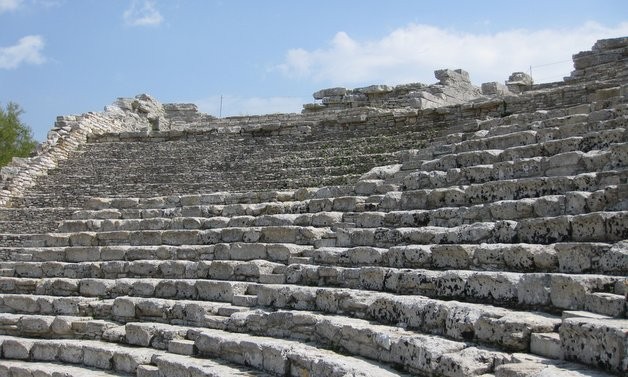
Image: Segesta Theater, Sicily