Br. Jacob Bertrand Janczyk, O.P.
Br. Jacob Bertrand Janczyk entered the Order of Preachers in 2010. He is a graduate of Marist College in Poughkeepsie, NY, where he earned a degree in biomedical sciences.
This Sunday, the First Sunday of Advent, marks the beginning of a new liturgical year for the Church. For the next twenty-three days, we turn our attention to the words of the prophet Isaiah: “Prepare the way of the Lord, make straight in the wilderness the paths of our God” (40:3). We know that the Christ child is on his way. The infant Christ, born in the stable because there was no room in the inn, surrounded by shepherds and animals, with the hosts of heaven singing glory to God . . . The story is all too familiar, so familiar that we can almost fail to notice, going about our daily routine as if nothing were changing.
Today, the Church celebrates the feast of St. Isaac Jogues and companions. St. Isaac Jogues was a Jesuit missionary priest martyred on October 18, 1646 by Mohawk Indians in present day upstate New York.
After entering the Society of Jesus in 1624, Isaac Jogues was sent to North America in 1636 where he set to work evangelizing the different Native American nations he encountered. Six years into his mission, Jogues and his traveling party were captured by a group of Mohawk Indians and savagely tortured. Cutting off his thumbs and index fingers, Jogues’s persecutors sought to render him incapable of celebrating the Mass. After 13 months of cruel enslavement, Jogues finally escaped and returned to France. Though priests with maimed hands were not normally permitted to celebrate the Mass, the Holy Father, Pope Urban VIII, granted a special dispensation allowing Jogues to celebrate the Mass once again. Zealous for the salvation of his persecutors, after recovering from his injuries, Jogues decided to return to his mission in the Americas. He was martyred one year later in 1646.
Abandon yourself to God . . . Admit your faults to Him and to your fellows. Clear away the wreckage of your past. Give freely of what you find and join us. We shall be with you in the Fellowship of the Spirit, and you will surely meet some of us as you trudge the Road of Happy Destiny. May God bless you and keep you—until then.
Type “trudge” into Google and you’ll get the following definition: “To walk slowly and with heavy steps, typically because of exhaustion or harsh conditions.”
The point of running in any race is to finish first. A track runner toes the starting line with the intention of beating the competition. Without this purpose, why bother?
Some weeks ago, during my ministry visiting the residents of a local nursing home, I was walking down the hall when I heard a resident call out to me. She was confined to a wheelchair, and when I stopped to talk with her she began to tell me that her leg was in considerable pain and no one had come to help. After talking for a few moments, she realized I was not a doctor and that I was not the person who could help her. So, with disappointment on her face and a wave of her hand, she said, “I don’t need you.” That was the end of our conversation.
Like New Year’s resolutions, Lenten penances often do not end the way we envisioned. As Jesus tells his disciples, “The spirit is willing, but the flesh is weak” (Matthew 26:41). We enter the season of Lent with the idea that, for instance, we will spend a few more minutes in prayer each day, or maybe give up some food that we love, or volunteer our time. For the first couple of weeks, things work out well, but, as life would have it, we run into complications. Things get busy at home, or at work, or with school, so we cannot afford to pray as long as we said we would on a particular day. We make compromises: “Well… frozen yogurt isn’t really ice cream.” Before we know it, it is Good Friday and we have not been to the soup kitchen in weeks.
Those of us who are in our first year of simple vows here at the Dominican House of Studies have just been assigned to new ministries in the Washington, D.C. area. These ministries vary widely. Some brothers run a parish youth group; others work with the Missionaries of Charity; still others visit the elderly at nursing and assisted care facilities. Most of our assignments require a certain amount of travel, but one of them—that of tour guide at the Basilica of the National Shrine of the Immaculate Conception—is just across the street.
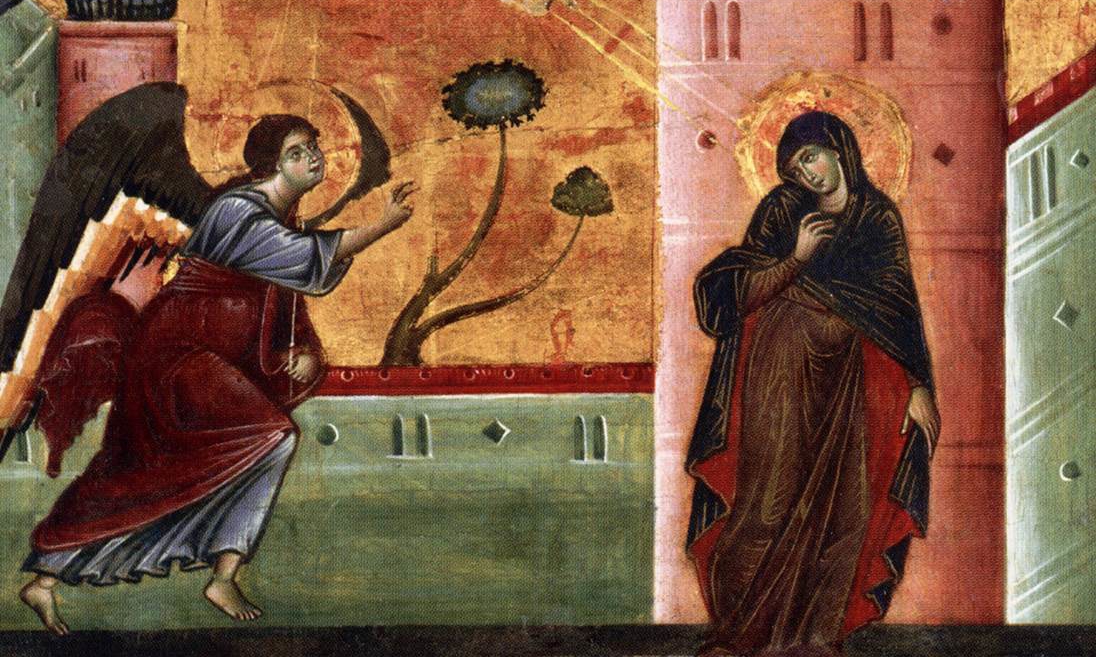
“Why do you delay, why are you afraid? Let humility be bold, let modesty be confident. If he should pass by because of your delay, in sorrow you would begin to seek him afresh, the One whom your soul loves. Arise, hasten, open. Arise in faith, hasten in devotion, open in praise and thanksgiving.”
These are the words with which St. Bernard of Clairvaux addresses the Blessed Virgin in a homily that we read during Matins on December 20th each Advent. The homily is incredibly beautiful and a great meditation at any point during the year, but I think that it is especially poignant just after Christmas. As we are still celebrating the Octave of Christmas, it is important to consider what the Incarnation of God means in our lives.
Our country prepares for the “holiday” season without rest beginning in October. This preparation, though, is all too often only on a material level: buying gifts, decorating, sending Christmas cards, etc. Once the 25th has passed, many people slip once again into the daily grind, and Christmas is put out of their minds until next fall. This is a legitimate danger even for those who hope to prepare their souls for the coming of our Savior by following the liturgies and disciplines of the Advent season.
St. Bernard addresses the Virgin with urgency. He implores her not to wait, but to proclaim her fiat to the Lord right away. He asks her not to fear because the whole world, even all creation is holding its breath in anticipation of her answer.
Three days past Christmas, we might consider how we would answer St. Bernard’s exhortations. Why do we wait, why do we delay, in saying yes to the Lord? What can we be afraid of? Each year, the Incarnation reminds us that God came into the world for us! He came to save us, but our salvation requires our participation, and God is waiting. He waits always, but the longer it takes for us to give ourselves to Christ, the longer we remain apart from Christ; the longer we only give a piece of our hearts to Christ; the longer we keep ourselves from true happiness.
St. Bernard says to Mary, “In this matter alone, O prudent Virgin, do not fear to be presumptuous. Though modest silence is pleasing, dutiful speech is now more necessary.” May the birth of our Lord and Savior, Jesus Christ, prompt such a “Yes” in us all, as it did in our Holy Mother, not only during this Christmas season, but in each moment of our lives.
Image: Edward Hopper, Cape Cod Morning
“All you need to do is sit down and shut up.” I vividly remember my spiritual director telling me to do this one fall afternoon while I was an undergraduate. I had stopped by his house on campus to talk about my discernment, and he, while sitting on a chair on his porch, told me to go to the chapel, sit down, and shut up. I also remember leaving our conversation a little annoyed, because that was not the answer I was looking for.
Some four years later I still think back to that afternoon and thank God, because it was some of the best advice I have ever been given. To be quiet with our Lord is one of the most difficult things to do. In a relationship, though, both people must talk and listen. Both must be open with one another, and both must be able to listen to and understand the other.
It can be easy to enter into prayer and to talk to God about our day, to praise Him for his goodness, to ask Him for help, etc. It can also be easy to get up and end our prayer after we have gotten to say what we felt like saying. This is all good and necessary. But this alone isn’t yet a complete relationship with God.
We have to sit and listen to what God is telling us. When we sit with the Lord and “shut up,” we give God the opportunity to talk to us. By closing our mouths (literally and figuratively), by trying to set aside the business of our lives for a few moments, and giving God all of our attention, we give Him the opportunity to answer our petitions and to fill us with His love.
God speaks to us in the silence of our hearts and of our souls. Our relationship with God is intensely intimate, and penetrates to the depths of our being. Unless we are willing to try and clear our minds of the business that invades our lives each day, how can we hope to hear Him?
God never stops communicating with us. Every second of every day, the Lord is speaking to us. Now the question to ask is: How often are we listening, and how intently are we listening? How can we ignore so often the One who loves us more than we could ever hope or imagine? When we are able to be with our Lord and “just sit down and shut up,” imagine what we will hear.
Image: Anonymous, Genuflection
A couple of weekends ago I happened to be walking through the National Shrine of the Immaculate Conception across the street from the Dominican House of Studies. When I entered the basilica I was immediately struck by what I saw. In all of its side chapels, both upstairs and downstairs, as well as in the Crypt Church, were priests hearing confessions. They were literally all over the basilica, and, even with so many priests, people were forced to wait in line to have their confession heard. Talk about being edified.
Seeing so many people having their confessions heard made me think about what attracts people to the sacrament. Why would you want to tell a man with whom you have no relationship the things that you’ve done wrong? It’s clearly not a comfortable thing to engage in. Yet, the Catechism of the Catholic Church teaches us that only God can forgive sin (CCC 1441), and that Christ gave this power to his apostles, and thus, their successors. (Mt 18:18).
Why is all of this important? Because God wants us for Himself. He wants us to love Him, to serve Him, and to live for him freely. He is waiting for us to respond to the grace He has bestowed, and to come to our Father for the help we need.
To love God and to become who we truly were created to be, we must turn to Christ. We cannot do it ourselves because we are the ones who have destroyed us. It’s amazing to browse through the “spirituality” section of a bookstore. All you can find are self-help books. How absurd to think that something broken can fix itself, but that is what we assume when we fail to realize our need for true forgiveness.
When we step into a confessional, we enter into an intimate dialogue with the One who loves us most, and we expect something to change. When we come before a priest acting in persona Christi, in the person of Christ, we recognize that this change cannot come from us. The saint is not the one without blame, but the one who acknowledges his or her powerlessness over sin, and turns to God.
This is why I was struck by seeing so many people going to confession in the basilica. It was a manifestation of the mercy of God. In the silence of the church people were crying out to the Creator to be healed. Seeing our sins is a grace, and when we turn to God, we beg Him to help us, and join with the Psalmist in saying, “For God has not spurned or disdained the misery of this poor wretch, did not turn away from me, but heard me when I cried out.” (Ps 22:25)
Image: Jose Piquer Y Duart, Penitent St Jerome