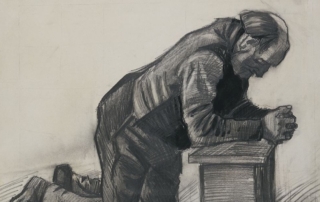
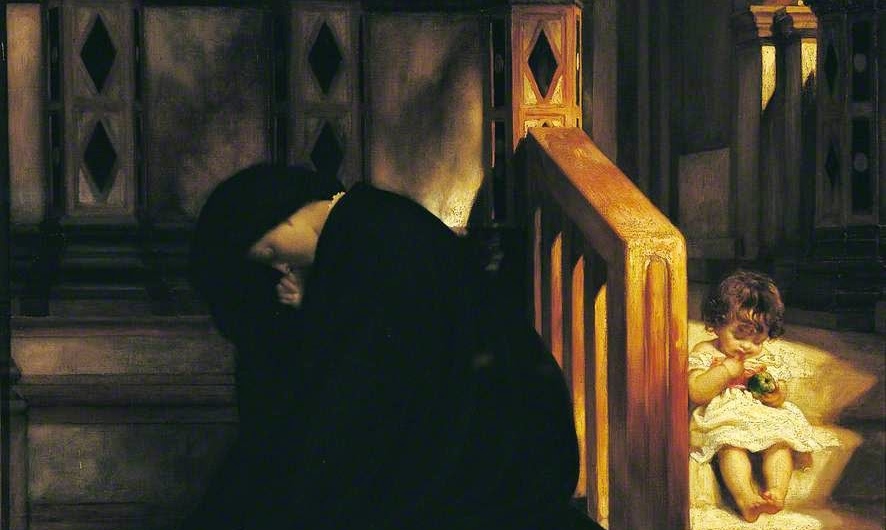
Being alone. It’s that all-too-familiar human experience. It lies at the root of our fears, ultimately making the vast wilderness frightening and the dark so haunting. The unnerving experience of being alone often descends upon men and women and has the power to paralyze them or otherwise entrap them in illusions of helpless desperation or worse, despair.
I would guess that if you are the type of person who reads a blog, you are also the type of person who uses email. And if you use email, then it is a healthy bet that you have sometimes found yourself checking your email quite frequently, perhaps every hour or every ten minutes. For me, it got to a point in college where it seemed like I was checking my email every three minutes. If you think about it, most of our email is quite banal: another mass mailing list has decided to express its commercial affection towards you, another friend has decided to send you a video of a talking dog, or you have received notice that your library books are overdue. What is it about using email that breeds this sort of habit? If we were to engage in any other activity so frequently, we would probably be labeled obsessive compulsive. Imagine going to your mailbox down by the street every hour! Perhaps you have always been a temperate email-checker or have an in-built disdain for email that has prevented you from checking it more than twice a day. If so, more power to you, but please indulge my use of this image.
Give a boy a patch of back yard to play in, and you’ll soon have some interesting critters on the kitchen table. Give him a few empty lots with a fence that fronts the Australian Outback, and there’s no telling what he’ll find. For twelve-year-old Roy Spencer, the day could have brought home a bird’s nest, a small reptile, or an old license plate, but his treasure that day was a hefty, shiny, black rock. The scene was predictable—mom looks delighted (but firmly commands it not to be left in the kitchen), later dad offers a half-hearted compliment after regarding the rock with the same feigned interest that he once showed to the dozens of other collectables that he’s tripped over this month. And you’ve guessed the ending: Roy’s clunky crystal transitions from imaginary treasure, to magical space shard, to windowsill decoration, to paperweight, to doorstop within two weeks—just another stubborn memento of a carefree summer vacation by the time school starts up again.
C. S. Lewis’ last sermon (since he was a layman he said he was “comparing notes”) was titled “A Slip of the Tongue.” He reflects on an experience of his in prayer:
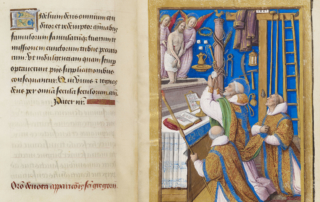
During his recent visit to the Dominican House of Studies, the Student Brothers were privileged to speak at length with patristic scholar Fr. Nageeb Michael, O.P., Director of the Digital Center for Eastern Manuscripts. Fr. Nageeb explained his current work which focuses on the preservation of ancient Christian manuscripts in the Middle East. In this, the first of three interviews with Fr. Nageeb produced by Dominicana, he discusses the beauty of praying in his native language, and then prays the Our Father and Hail Mary in Aramaic.
The Monastery of Our Lady of the Rosary in Summit, NJ was founded by a group of fourteen sisters from Union City, NJ on October 2, 1919. The following spring, a group of pilgrims from a nearby place spontaneously asked to make a pilgrimage to the new monastery in honor of Our Lady of the Rosary, and over the following years, the monastery became a well-known pilgrimage destination, receiving the name “Rosary Shrine”. Established with the mission of praying without ceasing, especially through the Rosary, in 1926 the monastery also established the practice of perpetual adoration of the Blessed Sacrament. After the nuns initially occupied an existing mansion creatively adapted to serve as a house of the Lord’s praise, the present monastery was completed in 1939. Situated on the top of a hill in Summit, a town so named on account of its elevation with respect to the surrounding suburbia, the Monastery of Our Lady of the Rosary is a center of prayer and peace within New Jersey.
I think it was Aristotle who famously said, “All men by nature desire to know [who the next Pope will be.]” Perhaps that is a bit anachronistic or syncretistic, but the point is clear: we are in papal buzz mode. Today, as the cardinals cast their first vote, we are all fixed intently on the Sistine chapel chimney more assiduously than curious kids on Christmas. I admit that the chatter and the twitter have been hard to avoid whether one has accidentally stumbled upon the cardinals’ social media scoreboard, or voluntarily downloaded iConclave. It seems many would trade in their humanity, just to be one of the frescos in the Sistine chapel’s ceiling, the conclave’s concave cover: “Please let me be a patriarch, a prophet, a sibyl, or at least a cherub on the wall—anything that will allow me to spy on the flurry of red beneath me and see the ballots strung on a string like popcorn or cranberries on an evergreen.”
Laugh and the world laughs with you;
Weep, and you weep alone.
For this sad old earth must borrow its mirth,
But has trouble enough of its own.
The famous opening lines of Ella Wheeler Wilcox’s signature poem “Solitude” provide a timely reminder of how to approach the home stretch of Lent. Seeing the rose-colored vestments yesterday on Laetare Sunday, we were given some food for thought as we continue our Lenten fasting in light of the upcoming triumph of Easter which draws ever nearer. After all, the word “laetare” is the command, “rejoice!” – which is an odd directive with more than two weeks of Lent still before us—to say nothing of the commemoration of the Lord’s Supper, Passion, and Death which come before the Easter Vigil. Yet everything we do as Christians must be seen in the light of the Lord’s Resurrection, not simply Christ’s passion. Furthermore, a spirit of joyfulness is consistent with the Gospel given us as Lent began on Ash Wednesday:
There is something about the Dominican way of life that people notice even if they cannot articulate it right away. The very atmosphere of the place, whether church or chapel or convent or monastery seems to be instilled with the peace and joy and awe that comes from the contemplation of God. All the monasteries of Dominican nuns are wonderful in just this way. Today I would like to draw attention to one in particular: our Dominican monastery in West Springfield, MA.
Last year in this space on the first Friday of Lent, I observed that the liturgy pointed us toward thinking of penance as warfare. We saw there how penance serves a spiritual volley against the devil. But while penance can do us good, God can also use our penance to benefit another.