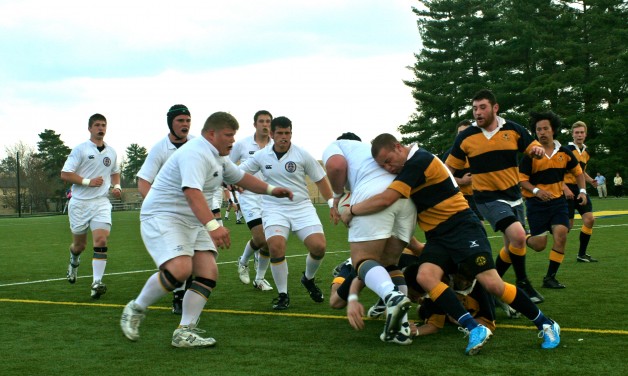
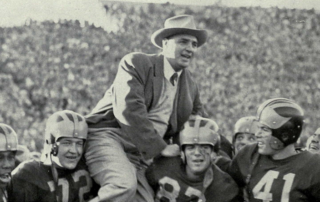
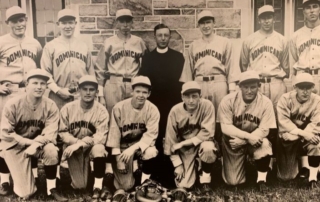
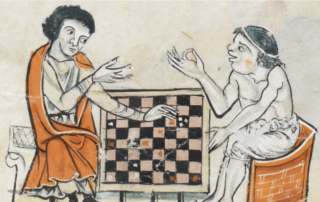
I am pumped! We are organizing a table tennis tournament at the priory next week (in cloister) to determine who will be the undisputed Dominican table tennis champion of the priory. One of the things I am doing to prepare the brothers is instructing them on the basic rules of table tennis. These rules can be a bit intimidating and can seem a bit too restrictive of what one can or can’t do. If someone has been used to playing table tennis a certain way and all of a sudden gets told she has been doing it all wrong, then her chances of winning the gold medal can be seriously hurt. What used to be a wicked awesome serve in one’s basement can be reduced to mediocrity in order to conform to a bunch of highly technical rules.
The Tough Mudder is twelve miles of physically challenging and psychologically intimidating obstacles with names like Mud Mile, Electroshock Therapy, Firewalker, Walk the Plank, and so on. There are about twenty-five obstacles in the whole event, and usually included are a few “mystery” obstacles. Participants are almost guaranteed to get scratched up, completely filthy, and slightly singed.
There is something amazing about watching the best athletes compete. In astounding feats of physical prowess, they stretch the human body to its physical and mental limits. Throw in a healthy dose of national pride, and you get the glory of the Olympic Games. Thousands of competitors from all over the world converge in one place for a great festival of sport, most of them competing in front of crowds larger than they have ever experienced, and all of them watched by massive audiences worldwide. This is probably the only time over the next four years that most Americans will even think about track and field or gymnastics, volleyball or water polo, and that’s not even mentioning the sports that don’t usually make prime time, like badminton, team handball, and men’s field hockey.
Whenever we make the decision to try to live “better” (be it healthier, or more uprightly, or more joyfully), the pursuit inevitably means confronting the contradictions that exist in our lives. Take, for instance, those of us who want to lose weight but also love late night snacking. These two desires are clearly at odds, and this conflict must be resolved before we can move forward—one must yield before the other. The same is true in the work of conversion: some things need to be cast off; others can be integrated.
The other day on a hike I noticed a mountain laurel bush jutting from the sheer wall of a rock tower, visible only to goat-footed hikers willing to climb up a mountain and scrabble over a series of shale-fissure rock formations just for fun. The laurel was a static explosion in white and green, as if the bush had been caught in the act of propelling itself off the rock wall, sending miniature blooms of white fire ahead as a vanguard. It was beautiful, and no one but the stray hiker will ever see it.
Right now is a great time of year to be a soccer fan. The European leagues are coming to a close, the MLS is just starting its season, the UEFA Champions League final is a week away, and the UEFA Euro 2012 is about a month away. That is a lot of soccer to digest in a short amount of time. All of this top-flight soccer prompts me to reflect on the beauty of the sport, which, after all, is known across the world as “the beautiful game.”
When baseball Hall of Famer Yogi Berra returned to his hometown of St. Louis for the first time during his rookie year, his community held an event to honor him. As the young Yankee catcher faced the crowd to acknowledge them, he proclaimed, “Thank you for making this day necessary.” Since he was nervous at the prospect of speaking publicly for the first time, he probably meant to say something else, like “possible” instead of “necessary.” But his gaffe—the first of many “Yogi-isms”—serendipitously provides a point for reflection this Easter: we thank God for making each day of our life necessary.
Every year at about this time I begin to experience an inner itch. The doldrums of winter are upon me, and the baseball season is still months away. With much anticipation I look forward to the start of spring training, followed by the crack of the bat and the pop of the glove on opening day.
The flourishing of the baseball season is a guarantee every spring and summer. The flourishing of our lives, however, is not. Time and time again we fail to thrive in our Christian vocation to live in the image of God. Even when the opportunity of a new season presents itself, we often turn away from all that will make us truly happy. We keep ourselves in the doldrums of winter.
Every athlete exercises discipline in every way. They do it to win a perishable crown, but we an imperishable one. Thus I do not run aimlessly; I do not fight as if I were shadowboxing.
—1 Corinthians 9:25-26
The 2005 film, Cinderella Man, tells the remarkable story of Irish-American boxer James J. Braddock (1905-1974). Braddock, played by actor Russell Crowe, enjoys a successful career as an amateur boxer until life takes a turn for the worse at the threshold of the Great Depression. Like so many other Americans during that tumultuous time, Braddock struggles to make ends meet, barely managing to support his wife and three young children. In the end, however—as the title of the movie suggests—his life plays out like a modern-day fairy tale. His boxing career gradually picks back up, and the film ends triumphantly when he becomes the heavyweight champion of the world. He and his family, as the saying goes, live happily ever after.
Braddock is portrayed as the kind of person we all want to rally behind. Yet our sympathy for him goes beyond mere support for the underdog, mere pity for his life of hardship. There is actually something we come to love in James Braddock: he is a good man.
Last week veteran NFL quarterback Fran Tarkenton wrote an article in the Wall Street Journal in which he mused on the intersection of faith and football. A religious man himself (“charismatic before charismatic was cool,” he says), Mr. Tarkenton raises some questions that not only have serious weight for football fans, but also provide an occasion for genuine theological reflection. “Does God care who wins football games?” he asks. Is which team wins important enough for God to care about? Should we look for divine causality in amazing plays like Roger Staubach’s 1975 “Hail Mary” pass and Franco Harris’s “Immaculate Reception” in 1972? Does having religious men on one team or the other increase the likelihood of winning? And finally, “If God gets credit for the win, does he also take blame for defeat?”
Since theology treats not only of God but of all things as related to God, let us see if the riches of the Catholic theological tradition can provide some satisfying answers to these questions, or, at least, help to advance the conversation.