Dominicana is a journal about culture, theology, and virtue, written from a quintessentially Dominican perspective. The friars who contribute to it—student brothers of the Province of St. Joseph—are training to become preachers of Jesus Christ, and this mission marks everything found here. The Dominican tradition of preaching and teaching is shaped significantly by the work of St. Thomas Aquinas. It is by drawing from this tradition, this way of understanding and spreading the Gospel, that Dominicana offers a distinctive voice to the modern conversation.
With the launch of this newly designed website, we take another step forward in a history that began with our first issue in 1916. Whether you are a new reader or a long-time friend of Dominicana, we hope you will find our new website usable and inviting. A good place to begin is the Our Vision section, which explains what this journal is all about, what informs our writing (the new essay Why Thomism?), and who we are, both collectively and individually.
The heart of our website, of course, is the content written by the brothers. We endeavor to provide something of lasting value to our readers, and so everything we publish is carefully reviewed by the student editors and by Dominican priests who serve as theological editors. In addition to finding essays under the broad categories of culture, theology, and virtue, you can also find related work at the bottom of each post, as well as work by the same author and recent posts.
Our new website brings together all our Dominicana content and offers many more ways to browse and explore the work of the brothers. Shorter essays published online every weekday, formerly published at Dominicana Blog, remain free. Print Journal content—longer essays, book reviews, and more—remains available to subscribers. Complete digital editions of recent issues are available in the Journal Archive. More back issues, including the first issue from 1916, will be released later this year to commemorate the 800th Jubilee of the Order of Preachers, and the 100th anniversary of Dominicana.
In the Marketplace section, you can purchase individual print and digital subscriptions, as well as access for libraries, religious institutions, or as a gift. Please consider subscribing, as your support sustains our writing and helps our growing studentate. Existing subscribers should be able to login with their existing account information—if you have difficulties doing so, please contact us.
Under Opera Omnia—the medieval Latin term for collected works—you will find a variety of ways to explore Dominicana. The first, Browse, showcases the featured artwork that is a Dominicana staple. Under the Blog Archive, you can browse by date and by category, or you can peruse the special featured series that offer a sustained treatment of a subject by one or several brothers over several essays. A variety of audio and video content—including recent talks and conferences, a video series on the Catechism for the Year of Faith, and the latest album from Dominicana Records—is also available.
We have also designed a new mobile version of the website, so you can read Dominicana easily on any device. We hope you’ll like us on Facebook and follow us on Twitter as well.
To mark this new chapter, we commissioned Matthew Alderman to draw our new logo, which depicts a familiar image from Dominican history: the dog with a flaming torch in his mouth. The dog is associated with St. Dominic and his Order, and the torch represents his burning zeal for preaching. The link dates back to a dream by our founder’s mother, Blessed Jane of Aza, while she was expecting him, and has been strengthened over the years by a pun on our Latin name: Domini-canes: the hounds of the Lord. Dominicana’s hound holds in his paws the shield of our province.
As sons of St. Dominic, we pray that we may have his zeal and his wisdom in what we write here at Dominicana. Most of all, we hope that God uses our efforts here as a means to draw our readers—and us—closer to himself. So whether you have been a faithful reader for years, or just discovered us today, thank you for reading Dominicana.
✠
New to Dominicana? Here’s a Taste of What We Write.
What No One Told Me About Catholicism
The Hobbit’s Guide to the Spiritual Life
Sacrificing Religious Life: A Response
Disputed Questions in Evolutionary Creation
The Annunciation and the One Ring
Jesuitica and the Dominican Post
✠
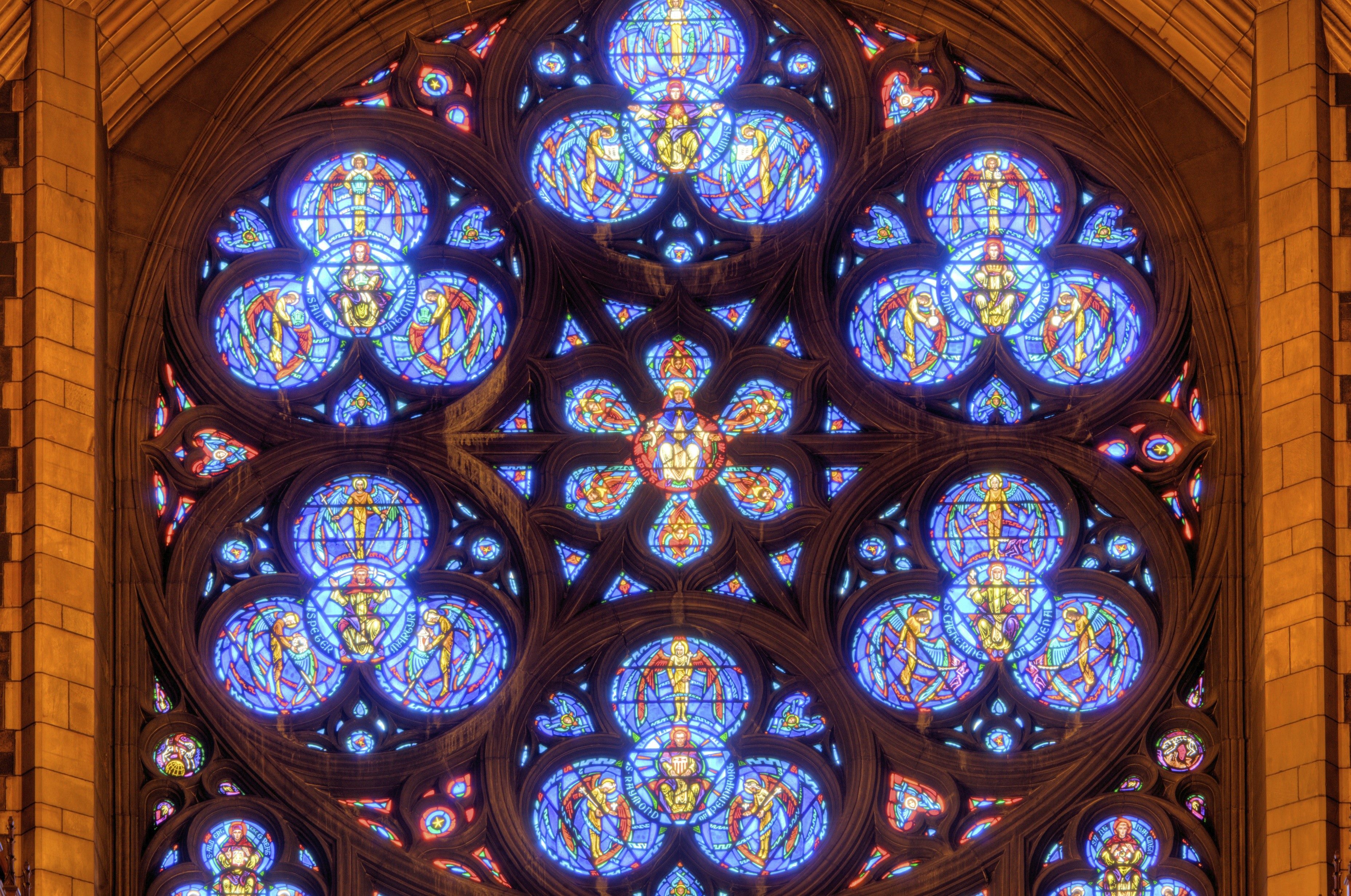
Image: Rose Window, the Church of St. Vincent Ferrer